*Disclaimer: The content presented in this website reflects the views of William Rouse, Student Physical Therapist and are not considered medical advice or intended to treat musculoskeletal disorders. The views expressed are not representative of the University of Findlay Physical Therapy program or the University of Findlay Athletics.
This article is a continuation of my last two articles, Experiments with Autoregulation Throwing Part 1 and 2:
As a quick recap, the throwing program I am performing was created by Clayton Thompson, affiliated with Driveline and the Los Angeles Dodgers. The concept is combining the ideas of:
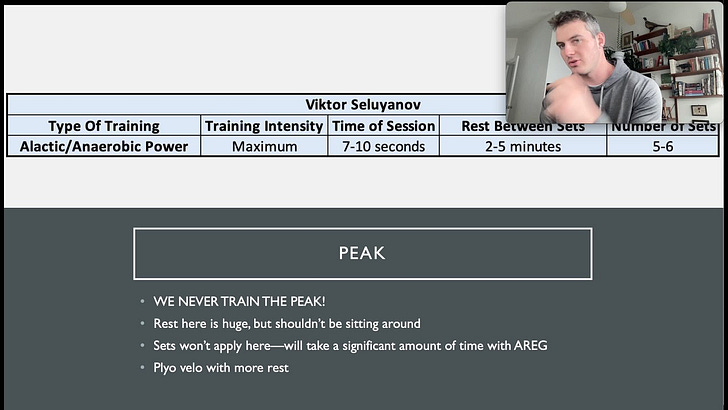
· No medium intent days, only low or high
· Go off of auto-regulation using percent drop-offs: if you feel good and are within the percentage, keep throwing. If you are not throwing within the percentages, stop throwing.
· Training peak days (how hard can you throw?) and training capacity days (how long can you throw hard?)
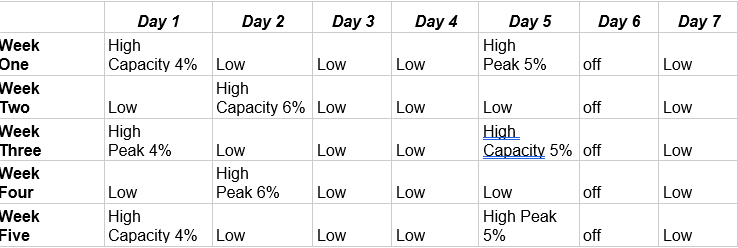
Below is the basic schedule I am following and a link to Clayton’s original video:
The article below will chronicle how weeks 4-6 of the now 6-week throwing program have gone, my thoughts on each day, and how I adapted.
10/6/25 High Capacity 4%
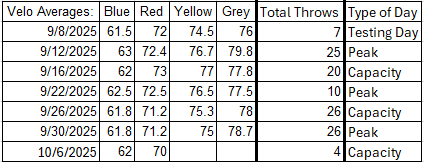
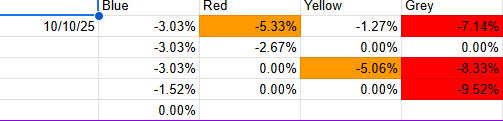
· This was a rough one, not going to lie. Even when I was warming up, I could tell I didn’t have it in me. All of my warm-up throws were down, and I just physically felt tired. My first two throws were well below the 4% mark, and I wasn’t holding anything back; on my last capacity day, I was operating mostly at the 85-90% effort level and succeeding, but today I was trying as hard as I could with no luck. While I probably should have been done right then and there, my ego tried to tell me I was still warming up and the next two throws would be better. They were not. In total, I made 4 throws on the day. On a normal program left to my own devices, I would have tried to push through the day. On this one, where I stop from digging an even bigger energy deficit, it seems like there is less concern for deloading, as every other week has a 5-day period of low throwing. Because I canned this day, and my next peak day is in 4 days, I have essentially given myself 9 days between my last heavy volume velo day. Hopefully, this makeshift deload will allow me to bounce back next week as I approach my final 3 throwing days.
· 10/6/25 results:
· Percent drop-offs:
10/10/25 High Peak 5%
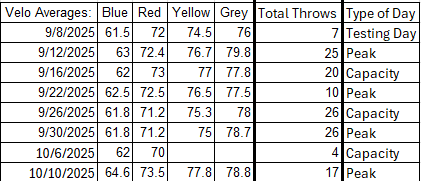
· Huge day for the program! In 17 throws, I set new baselines for each ball, setting personal bests (during this throwing program) on each plyo, hitting 66mph with the blue ball, 75mph with the red, 79mph with the yellow, and 84mph with the grey. Cutting the last throwing session early clearly did me some good. With only 1 velo day left on the 6-week program, I am peaking at the right time.
· 10/10/25 results:
· Percent drop-offs:
10/14/25 High Capacity 6%
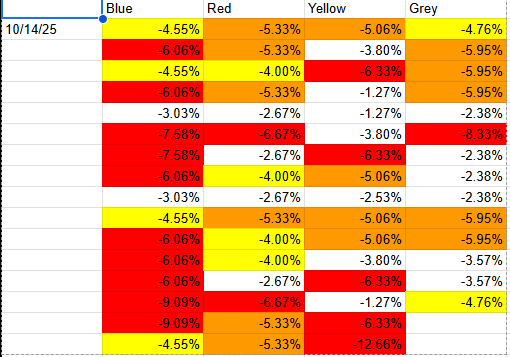
· 62. I made 62 throws today. I stared down the dreaded 6% drop-off day, and I didn’t budge. I had throws that fell below the 6% threshold, but in sets of 2, I was always able to have at least 1 of the throws at or above the 6% threshold, so I kept going. I don’t have any idea why I all of a sudden had over double the amount of throws I previously had in the tank. Last throwing session I had all of the PRs, so maybe I finally had a breakthrough of adapting to this program and rebuilt my arm endurance. Maybe it was just one of those days. I had gotten off from my clinical and went straight to the facility to throw, so it’s not like I had optimal conditions. Regardless, for the last throwing session of the current program, what a way to end it!
I do not recommend that other athletes be willing to more than double their previous workload. Some safety guidelines should be implemented to make sure an athlete is built to handle that kind of volume beforehand. For me, a retired athlete, I chose to keep going to fully test this concept, knowing that my elbow doesn’t matter.
· 10/14/25 results
· Percent drop-offs:
Conclusions
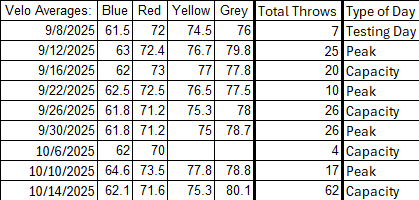
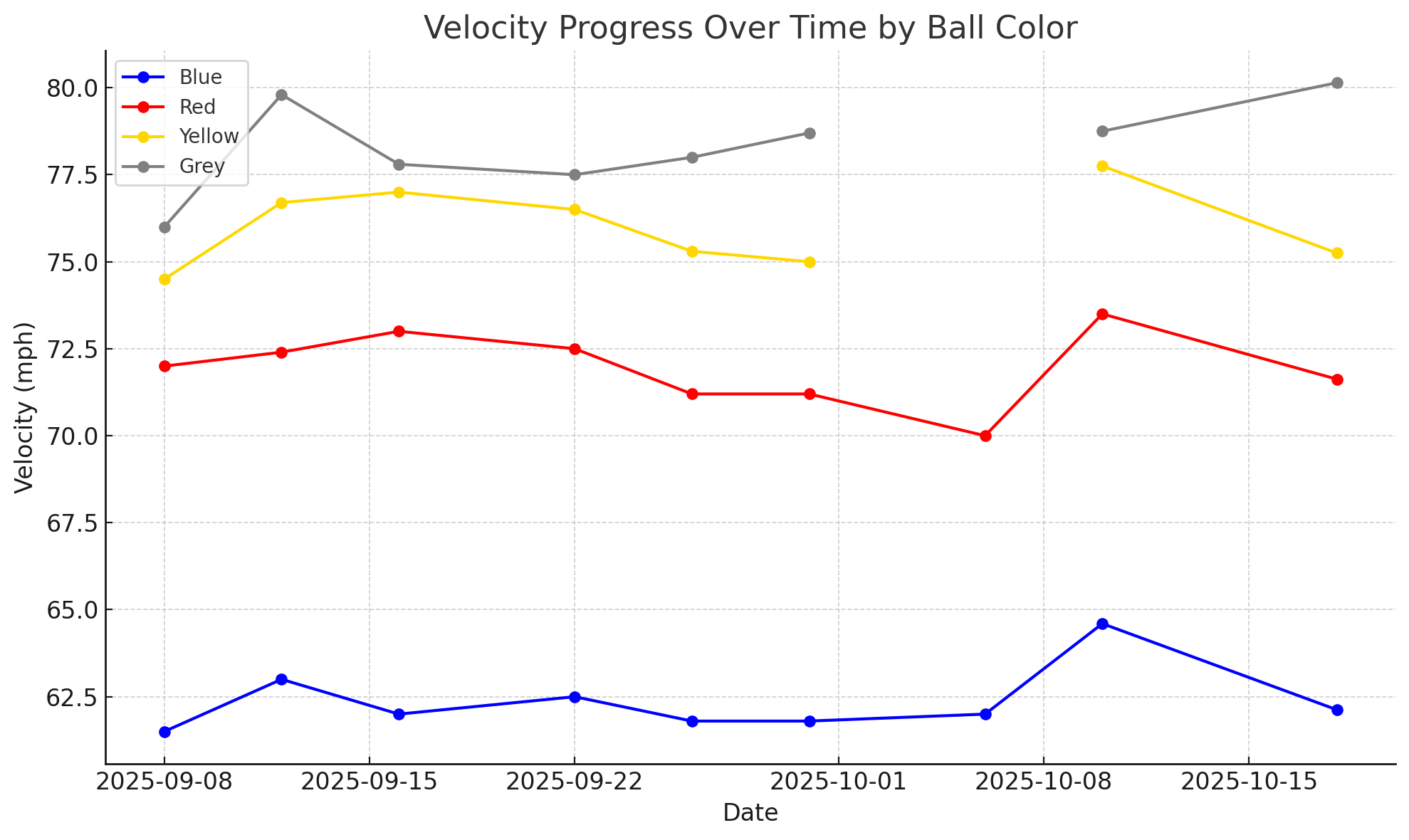
I had a ton of fun running these concepts of autoregulation from Clayton Thompson’s throwing program. From the start of the 6-weeks to the end, I saw the averages increase on each plyo throw across the board:
Some of the things I liked about the autoregulation throwing:
· Applicable to any throwing program
o While I chose to apply the concepts to a walking windup plyodrill, utilizing percent drop-offs and alternating capacity vs peak days can be applied to any throwing drill, mound velos, pulldowns, etc., and can be utilized with different throwing setups. Depending on where you are at in the offseason, this can be very useful
· Lots of rest
o One of the common flaws I see with athletes is going too hard on medium days and even on recovery days. This lack of recovery leads to under-performing velo days where they still throw 15-25 throws and dig an even bigger energy deficit, leading to an early deload period. Clayton’s throwing program minimizes that factor as far as possible. With no medium days, there is less temptation to overthrow. While the recovery days can still be overdone, the autoregulation on the velo days provides a sort of check and balance due to the fact that if you are tired going into the day, you’re only going to get 4 throws in before you are forced to stop (like I did.) The program is set up to never let you dig too big an energy deficit. I have had months previously where I would be forced to deload by week 4 because I had already lost 4-5mph off of my top fastball. On this program, I was peaking still in week 6. The program is written with mini-deloads throughout as needed, making emergency deloads far less necessary.
· Perfectly set up for offseason throwing
o The argument against this program, that Clayton Thompson brings up, is that without the medium days, you never work on the skill of pitching. Clayton’s counterpoint (paraphrased) is that if you’re throwing slow, no one cares what your fastball or slider shape is anyway. I agree with this sentiment, that in general, the biggest limiting factor for most pitchers is velo, and some trade-offs should occur to make it happen. I also think that aspects of this throwing program could be implemented into even more established throwers. Following general concepts of periodization, where you start the off-season working on more general skills and progress to more specific, you could start an off-season running this program with pulldowns or plyo velos, progress to mound velos, and then as you get closer to the season, start integrating less true rest days and switching focus from velo to command/pitch design. Just because you start an off-season utilizing a type of program does not mean that is how you have to finish it. Even sprinters have periods of their off-season focused more on the gym than sprinting; not all of pitching training has to be game-specific.
Some of the things I thought could have been done differently/counterpoints with the autoregulation program:
· Easy to take advantage of
o The high-low system and utilizing capacity vs peak days is going to be highly dependent on the athlete actually sticking with the plan. Clayton brings up how in the gym, there will always be the guys who think they can grind out another set and there will always be guys trying to avoid doing more work. I had a day in my throwing where ego got the better of me and I turned a capacity day into a peak day. Furthermore, every pitcher I have ever known loves to throw 80mph+ on supposed “recovery days”; on a program that is dependent on extremes, misuse of recovery days is not an option. If I were going to run this program with an athlete, I would both be selective in the athletes I prescribe this program to and I would like them to utilize a Driveline Pulse if possible. This would give me a better gauge on whether recovery days were actually being used for recovery.
· Same percent drop-off for each weight plyo
o This is more of a question I had than a dislike of the program. In my career, I had typically thrown the grey ball/underload ball the worst; when I was peaking 93mph on the mound, I was only throwing 86-87mph on a walk-in wind-up drill with the grey ball (these velos are typically very similar.) Depending on what an athlete was focused on, it seems like you could manipulate the percentages to get more work in either the underload or overload implements. For example, if I wanted to focus in on the underload on a peak day, maybe my cutoff percent for the blue and red balls (450g and 225g) would be 4%, but my cutoff for the underload weights, the yellow and grey (150g and 100g) could be 5%. This would hypothetically allow me to get more work with the lighter implements and improve upon it. Now, whether you agree with whether I should focus on lighter implements because they are my weakness or heavier implements because they are my strength is a whole other argument, but it does stand to reason that these variables could be easily manipulated.
· Throwing Volume
o Again, while not really a concern of mine, Clayton brought this up as a potential counterargument against his throwing plan, that with no medium days, the workload would never reach adequate levels for in-season pitching or for safety. I tracked my throwing with a Driveline Pulse to measure the workload change. I started the program around a 5.5 workload and finished at 5.3. A chunk of this was estimated based on total throws and velocity due to me moving back home and starting clinicals, so take the actual number with a grain of salt, but it still is adequate enough data to demonstrate a few things:
§ While a 5.5ish workload is not high enough for an average active athlete, no one cares what your workload is if you throw slow, as Clayton brings up
§ This workload was created using plyo velos. Pulldown days and mound velos are typically much higher workloads. For example, when I played, my average plyo velo workload day was around 12-14 while my mound and pulldown days were 17-22. If done with non-plyos, I think it’s safe to say the workload would have been higher.
Overall, I think this program is great for athletes who have a long off-season or are searching for velocity. I would recommend having a coach run the program who can help monitor the athlete’s workload and ensure there is an actual difference between the capacity and peak days. I would also recommend utilizing a Driveline Pulse for workload management. I think even if I weren’t running this program, I would apply the auto-regulation cut-off percentages to all of my future velo days. It just makes sense that if you are down 4, 5, 6% on a day, you aren’t accomplishing much by pushing through it. Might as well take it as an extra recovery day for the next week. I wanted to conclude by saying thank you to Clayton Thompson for supplying the idea and the blueprint for this program!