Experiments with Autoregulation Throwing
Testing Clayton Thompson's Throwing Program Part 2

*Disclaimer: The content presented in this website reflects the views of William Rouse, Student Physical Therapist and are not considered medical advice or intended to treat musculoskeletal disorders. The views expressed are not representative of the University of Findlay Physical Therapy program or the University of Findlay Athletics.
This article is a continuation of last week’s article, Experiments with Autoregulation Throwing:

As a quick recap, the throwing program I am performing was created by Clayton Thompson, affiliated with Driveline and the Los Angeles Dodgers. The concept is combining the ideas of:
· No medium intent days, only low or high
· Go off of auto-regulation using percent drop-offs: if you feel good and are within the percentage, keep throwing. If you are not throwing within the percentages, stop throwing.
· Training peak days (how hard can you throw?) and training capacity days (how long can you throw hard?)
Below is the basic schedule I am following and a link to Clayton’s original video:
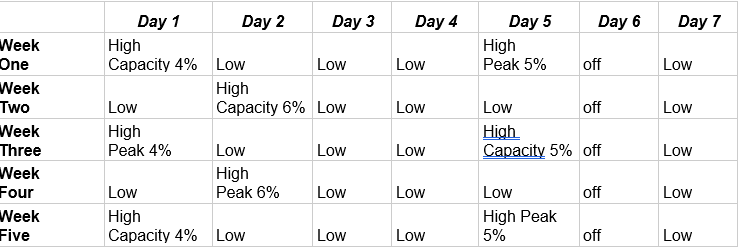
The article below will chronicle how the first 4 weeks of the now 6-week throwing program have gone, my thoughts on each day, and how I adapted.
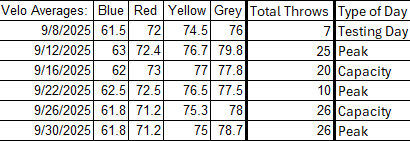
9/8/25, High Capacity 4%
· Well, this day got severely screwed. The pocket radar died (never use batteries) before I had a chance to finish, and I only got a few throws in. I will treat this day as baseline findings, I guess. From my peak velos from my playing days, my numbers are down considerably. This raises a couple of limitations to my findings. There is the limitation that I am not at peak throwing shape anymore, so the results, whatever they may be, may not be fully applicable to active players. The other limitation is that muscle memory is a real thing; I might see velo gains just from having previously thrown harder, especially since my last peak velo day was only 8-9 months ago. It will be interesting to see how quickly the velo rebounds.
9/8/25 results:

9/12/25, High Peak 5%
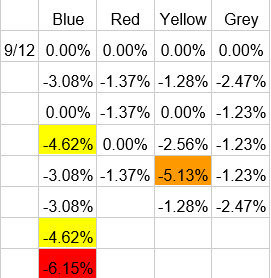
· This throwing day took an hour and a half, warm-up time included. My arm felt a lot better, and all of my velocity numbers were up considerably. It’s hard to say if this was due to muscle memory, getting back into the groove, or the throwing program (probably all of it). My arm felt lively going into it, well recovered from the super abbreviated first velo day. I took 2.5-minute breaks between each 2-3 throws (I would throw an extra ball if I still felt good). The long recovery periods were annoying at the start of the period. However, by the last few sets, I would have benefited from increasing the rest time. I tried to keep my arm moving during the break, as Clayton recommends. I would do some low-effort pivot picks and other drills. I made a total of 25 throws before I reached the 5% drop-off threshold. I had a couple of throws early that had a 5% drop-off, but I kept going until I had either 2 in a row, or where I had 2 in a set of 3 throws fall below a rounded 5%. It will be interesting to see going forward if there is any correlation between which weighted plyoball I see quicker declines. Early results show larger percentage drop-offs on the blue ball.
9/12/25 results:

Percent drop-offs:
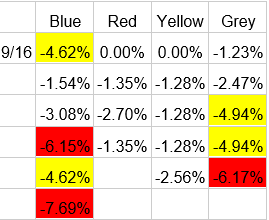
9/16/25 High Capacity 6%
· This throwing day was around an hour, give or take 10 minutes. I made 20 throws to get to a 6% drop-off. Clayton hypothesized in his video that the high-capacity day would take the longest, as you do not need to throw max effort, you just need to maintain over the 6% threshold. Here is where I think that idea didn’t work, and some of it is user error. First, as a former reliever and now out-of-shape pitching coach, my endurance is incredibly low. The longer breaks suited me well, and going down to 1-minute breaks between sets probably hurt me more than a pitcher who has been properly built up, as they have to rip a pitch every 20-30 seconds. Second, a 6% decline sounds large until you rip a blue plyo ball at 65 mph. That meant a 6% drop off was only about 61mph. For me, living between 62-65mph without trying to max effort the ball was a hard task; I was unable to cruise at 90% effort to achieve that. This is different than a guy throwing 100mph, and a 6% drop off would be down to 94mph. At least for making this program work with plyo velos, I almost feel like the drop-off percentage has to be slightly different per weight. For example, while I had trouble regulating my effort throwing the blue plyos, the 5-mph differential between my peak and 6% threshold on the yellow and grey plyos was much easier to be within, and I could have cruised at 90-95% effort, retained some energy, and still have been in that range. The extra mile of room makes a difference. Instead, I let my ego get the better of me, and I tried to max effort on those balls as well. While I kept the rest the same as a capacity day, I did not follow the intent guidelines as well as I should have. This is a risk Clayton brings up, that when performing autoregulation, there will always be guys who take advantage of it, whether by performing too much work or not performing enough. This is something I will have to pay more attention to if I want to get a true sense of the potential of this throwing program. I may make this program an extra week long (6 weeks) to make up for the lack of data on the first throwing session and the lack of truly testing capacity on this day.
9/16/25 results:

Percent drop-offs:
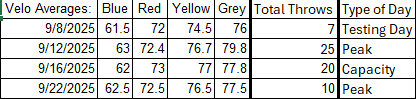
9/22/25, High Peak 4%
· I went into the day not feeling great. I just felt physically drained after a long day of classes and coaching, which is absurd since I had 5 days of recovery leading up to this. My first few throws were right on par with my standards, but once I hit the grey ball, it was all downhill. I only got 10 throws in, with the last two falling below the 4% threshold. I took 2-2.5-minute breaks between sets. Since I wasn’t feeling great, I was only doing sets of 2 throws. Normally, if I were left to my own devices, I would have powered through the velo day, putting up bad numbers and digging an even deeper energy deficit to climb out of, requiring an early deload. On this program, since I was no longer “peaking” (being within the 4%), it was assumed I was no longer benefitting from throwing and would be better off starting my recovery. I wonder if this strategy of autoregulation will allow me to avoid a deload longer, or when I come back on Friday, will I still be in a deficit?
9/22/25 results:
Percent drop-offs:
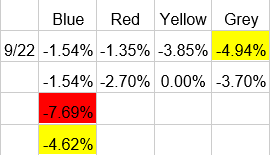
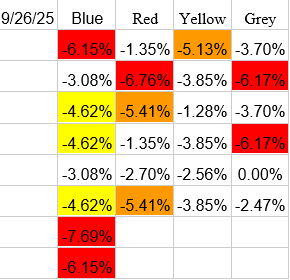
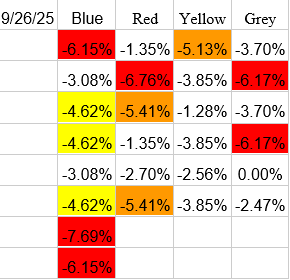
9/26/25 High Capacity 5%
· I think I got the high-capacity day figured out. I made a conscious effort to stick to the percentages I set out. Last time, I made the comment that it was too hard to try and just throw at the effort I set; the range wasn’t big enough. I made several adjustments to make this work. The first is that I wrote out my velo goals ahead of time that would accomplish 5% drop-off. For example, for the blue ball, it was about 61.5mph. I then used my warm-up throws to figure out what percent perceived intensity got me around that number- it was about 80-90% effort. I then made the choice that, instead of trying to beat that number on all of my throws, I would be ok if I threw some under the threshold. I figured that I would only stop throwing if I fell below the threshold 2x in a row, same as I do on the peak day. That way, if I was coasting at 80% and I had a throw fall below the threshold, the next one I could easily up the effort to 90% and be back in the range. This helped better differentiate the capacity day from the peak day, where any throw below the threshold would indicate fatigue, as I am trying to max effort throw on those days. This resulted in a much wider range of throw percentages, but a truer capacity day than the last one I performed. I made 26 throws, with the last two falling below the 5% threshold. Interestingly, even trying to throw at 80%, I occasionally threw some of the balls (specifically the grey ball) near/at my peak and had to drop the perceived effort level even lower. I have a tendency to want to muscle up the lighter balls and not allow my arm to accelerate; I try to throw hard, not throw fast, and there is a difference. I think that the 80-90% perceived effort allowed me to actually relax and allow my arm to accelerate the grey ball instead of me hijacking the throw with unneeded effort. I once had the pleasure of hopping on a phone call with Ben Brewster, and one of the things he talked about was using my recovery days and hybrid B days (medium days) to figure out how easy I could throw hard. If the goal velo of the day was 84mph, how could I improve my sequencing to throw that velo at an even lighter perceived effort? I am guessing that when I dropped the effort level down and was just trying to hit the bare minimum, I may have started to demonstrate improved mechanical sequencing within the drill, throwing harder with less effort.
9/26/25 results:
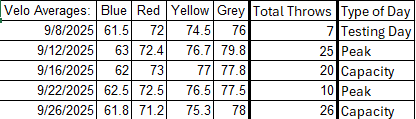
Percent drop-offs:
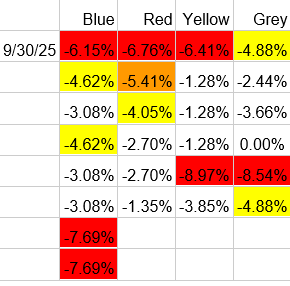
9/30/25 High Peak 6%
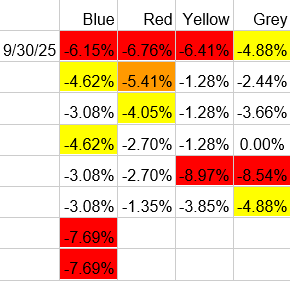
· I made 26 throws before I had 2 in a row fall below the 6% threshold, but it was a battle. My first 8 throws, I basically alternated falling below the threshold and having to dig down deep and throw the next one harder, so that way I could keep going. I don’t know if I finally warmed up or if I just willed myself to victory, but I was able to stay within the threshold for a decent amount of throws afterward. The percent drop-offs ended up looking more like a capacity day, even though I was trying to throw at max effort. This is demonstrated by the velo being down from the last peak day, but looking eerily similar to the last capacity day. However, I did PR on the grey ball on throw #16 at 82mph.
9/30/25 results:
Percent drop-offs:
(part 3 coming soon: rest of throwing and my final thoughts)