
Throwing a Sweeper
How I approach teaching a sweeper

*Disclaimer: The content presented in this website reflects the views of William Rouse, Student Physical Therapist and are not considered medical advice or intended to treat musculoskeletal disorders. The views expressed are not representative of the University of Findlay Physical Therapy program or the University of Findlay Athletics.
The sweeper. It is a pitch that exploded onto the scene a few years ago, peaked last year, and now has settled in as a normal tool in a pitcher’s arsenal. But what is it? Why would you want it over a regular slider? And how do you learn to throw it?
The sweeper is, at its core, a really big slider. A traditional slider at the MLB level is 85mph with 6in of horizontal movement towards the glove side of a pitcher (a right-handed pitcher's slider would break to the left)1. A sweeper averages 82mph at 15in of glove side horizontal movement1. So, the sweeper is a slower, bigger-moving slider. Why would we want this? The sweeper is a fantastic platoon pitch, averaging an xwOBA of .258 for RHP vs RHB2. The slider, in comparison for RHP vs RHB, only had a .282 xwOBA2.[1] https://x.com/PitchingNinja/status/1656723282459078658
LHP vs LHB shows an even greater platoon potential, limiting LHP to just a .220 xwOBA (sliders were at .246)2. So, as it has been shown, sweepers are better than sliders on average at limiting same-handed hitters from hitting the ball hard. It can be hard to control at times, as the bigger a pitch gets, the harder it can be to throw it in the zone. Pitchers who are struggling with generating outs and weak contact against same-handed hitters may benefit from adding a sweeper to their arsenal, especially in strikeout counts where hitters are more likely to chase out of the zone and command in the zone is not as important.
So, how does one throw a sweeper? How does one differentiate it from a traditional slider? The main difference in creating the movement profile is that a slider's spin efficiency, the amount of spin that adds to the movement of a pitch, is usually 0-30%, spinning more like a football. A sweeper needs to be between 40-60% spin efficiency, having a higher amount of spin contributing to the movement2. Two ways that have worked well for me in promoting this higher spin efficiency are using oversized balls and using dot balls. My driveline coach and mentor recommended throwing oversized balls with a sweeper grip to promote efficiency on the slider. This was done with the oversized Driveline command balls, specifically the 5 and 6 oz, though a softball would have also worked. I would throw these balls out of my sweeper grip from 120 ft with the sole goal of trying to make the pitch break as large as I could. From a larger distance, and with the oversized balls, you get immediate feedback on whether you threw the pitch well or not. The dot ball is a tool I recently started playing with, learned from Pitching Coach U and seen applied at Velocity Sports, and can be applied similarly.
Following the dot placements he describes in the video, you can create a ball that will give you immediate feedback when throwing it. If the dot is facing you, the less efficient it is. The more the dot is in the bottom corner of the ball (bottom left-hand corner for LHP, bottom right-hand for RHP), and away from you, the higher the efficiency and more ideal sweeper orientation. Cueing to help get the shape with these tools is to “throw it like a curveball, throw it like a sideways curveball, or come around the ball.”
Grips for sweepers vary, but most utilize 1-seam or 2-seam grips due to the seam-shifted wake effects (SSW) that need to occur to create the sweeper shape.[2] Explaining how SSW works in depth is a whole other article, but for now, just understand that the movement we are trying to achieve will be incredibly difficult without SSW. I tried a couple of grips and settled on the one shown below, with my fingers between the two seams with the nose of the ball slightly turned up. One alteration to try if struggling with the shape is adding a knuckle variation, as that can help some pitchers get around the ball easier. Keep playing with the grip until you find an orientation that works. Pitching ninja also has a whole folder of grip variations that are worth exploring. https://x.com/PitchingNinja/status/1935706605703586148
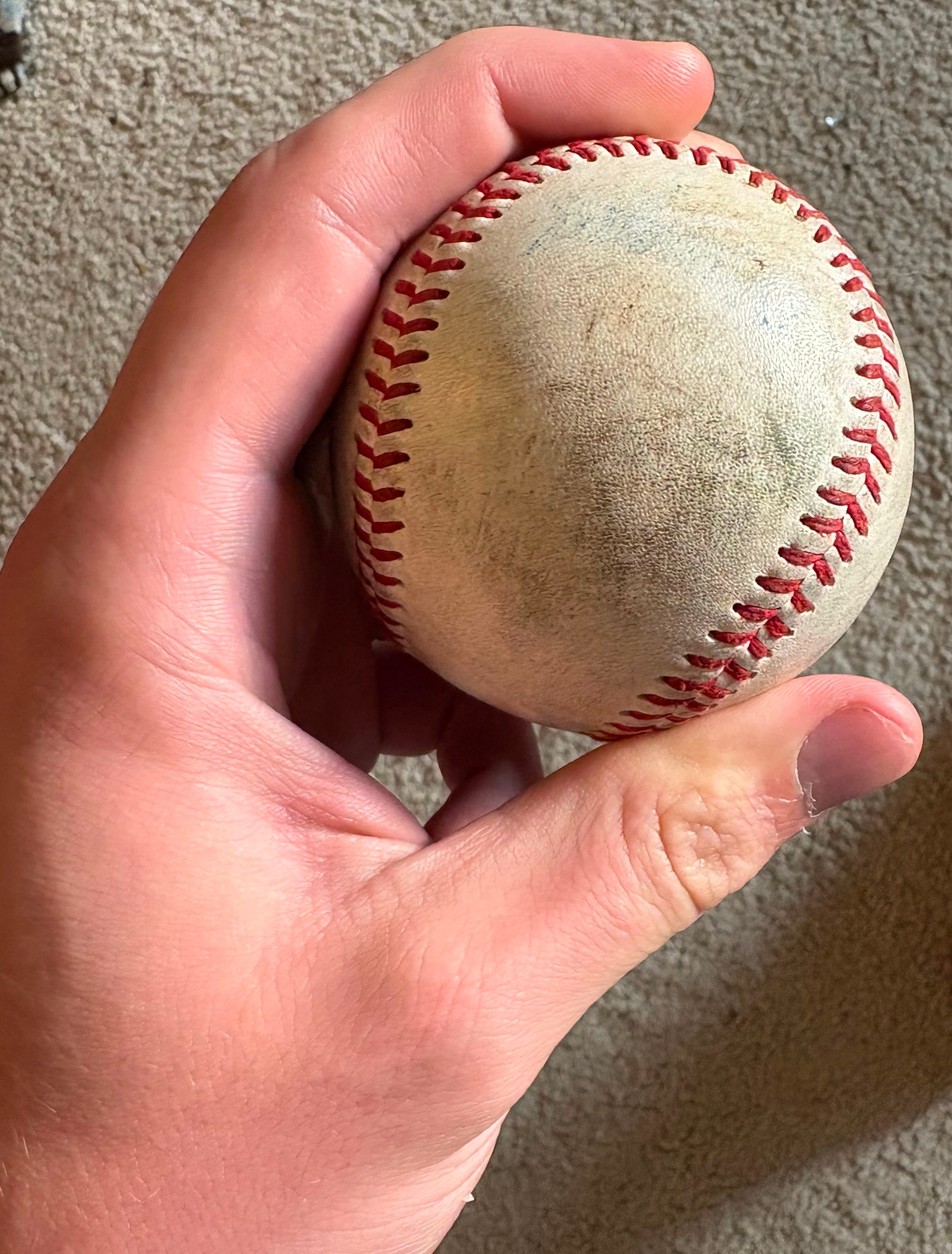
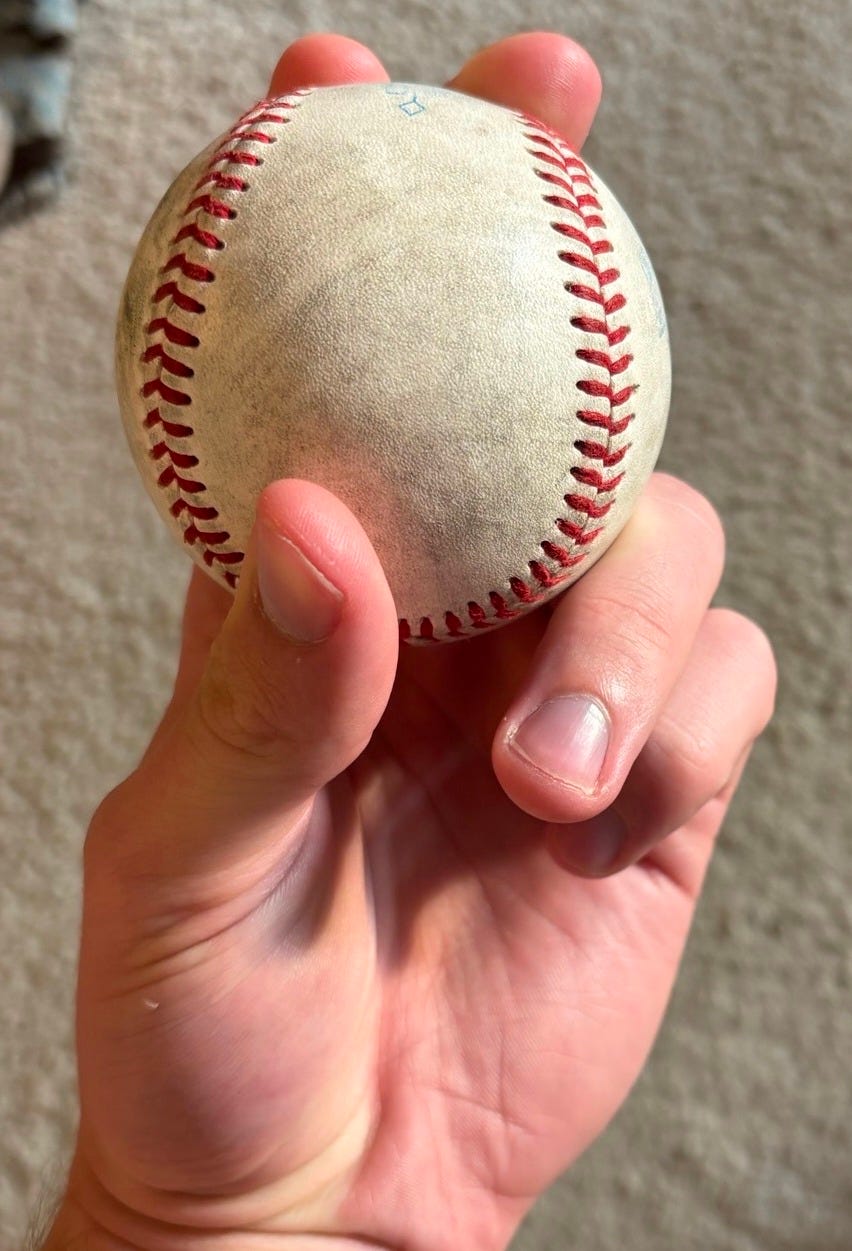
My own career with the sweeper had many ups and downs. Early on, I was getting the correct spin efficiency, but only 7-9in of sweep. Switching grips to a more standard sweeper grip helped correct this and increase the size of the pitch. In the game, it was devastating against other lefties, but I really struggled at times to avoid hitting right-handed batters with it. In bullpens, I would work on 2 locations for righties, an in-zone sweeper and out-of-zone sweeper, but eventually it just became easier to develop a third pitch (a splitter) over continuing the struggle of locating it. I was able to get the sweeper up to 18in at times, and if I were to do it over again, I would have tried to tighten up the size against righties in trade for velocity and better control. With these larger pitches, there will always be a tradeoff of size for command/velo, and it's up to the pitcher to figure out what is optimal for them.
To recap, we throw the sweeper for the main purpose of generating weak contact against same-handed hitters. The pitch requires a higher level of efficiency than a standard slider. Try using oversized balls and dot balls, anything that can help provide immediate feedback.
References
1. The hot new pitch that’s sweeping across the Majors. MLB.com. Accessed May 20, 2025. https://www.mlb.com/news/sweeper-slider-latest-pitching-trend-explained
2. Gaynor J. Pitch Design “U.” Published online 2024. Accessed May 20, 2025. file:///C:/Users/Willr/OneDrive/Desktop/Important%20Baseball%20Documents/Pitch_Design_U_Presentation.pdf
[1] xwOBA: Expected Weighted On-Base Average. Here is a link to MLB’s definition: Expected Weighted On-base Average (xwOBA) | Glossary | MLB.com. Essentially, xwOBA takes more into account the factors influenced by the pitcher and hitter, like exit velocity and launch angle, and does not take into account factors they have no control over, like defense. The goal is to take as much “luck” out of the equation as possible and predict the Weighted on-base average, or for pitchers, weighted on-base average against, if factors like above average or below average defense didn’t exist.
[2] Seam Shifted Wake is a way to cause the ball to move. This is based on creating asymmetry with the seams on the baseball utilizing certain baseball grips.